

How Laser Engraving Machines Are Transforming Modern Manufacturing and Design
The Growing Role of Precision Engraving
Across manufacturing, retail, and industrial sectors, there is a growing demand for detailed, repeatable marking that can be produced at scale. Products need clear identification, consistent branding, and durable markings that hold up over time. As production volumes increase and tolerances tighten, manual engraving methods are struggling to keep pace with modern expectations.
This shift has led many businesses to move away from hand engraving and mechanical processes toward automated systems. Accuracy and consistency are no longer optional in production environments where even small variations can affect quality control, traceability, or brand perception. Automated engraving solutions address these challenges by delivering precise results with minimal variation from one item to the next.
Laser engraving machines play a central role in this transition. They combine digital control with high-precision output, making them suitable for both small workshops handling custom jobs and large-scale operations focused on efficiency. Their versatility has made them a practical tool across a wide range of industries, as highlighted by Epilog Laser.
How Laser Engraving Technology Works
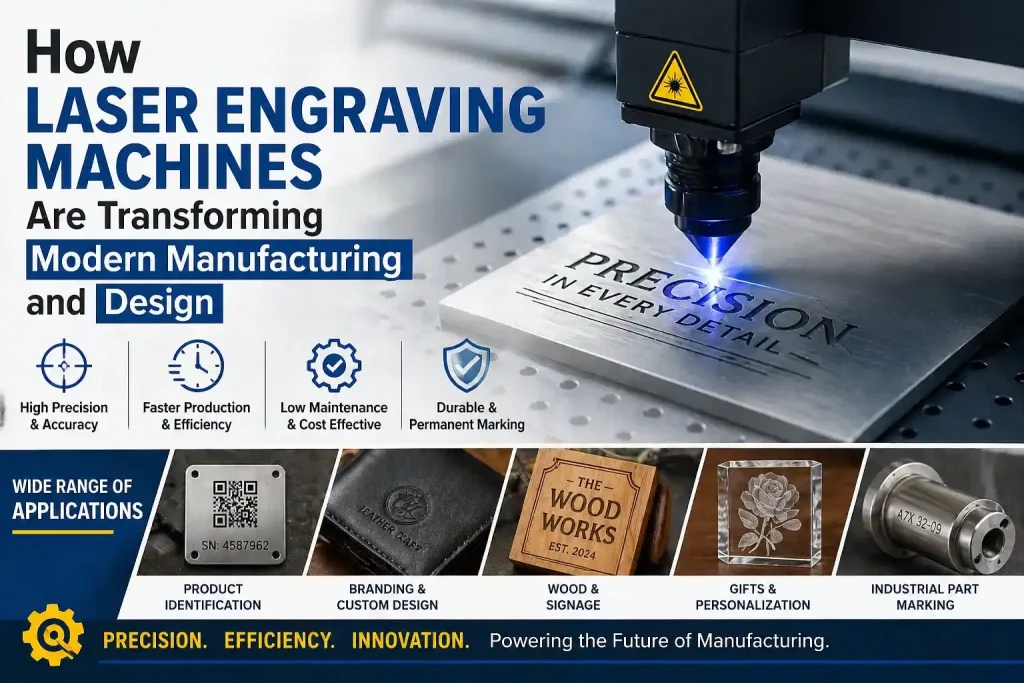
Laser engraving technology works by directing a focused beam of light onto a material’s surface. The laser generates enough heat to alter or remove material in a controlled way, creating permanent marks without the need for physical contact. Because the beam is digitally controlled, the process offers a high level of accuracy.
It is important to distinguish between engraving, marking, and cutting. Engraving removes material to create depth, marking changes the surface without significant depth, and cutting fully separates material. Many machines can perform all three functions depending on power settings and configuration.
Common materials suitable for laser engraving include metals, plastics, wood, leather, glass, and certain composites. Software plays a key role by translating digital designs into precise movement paths, ensuring repeatability and allowing complex designs to be reproduced consistently.
Key Benefits Compared to Traditional Engraving Methods
One of the main advantages of laser engraving is reduced material waste. Because the process is highly controlled, there is less risk of errors that lead to scrapped parts. The non-contact nature of laser engraving also minimizes the chance of damaging delicate components.
Consistency is another major benefit. Once settings are defined, the same result can be achieved across high volumes without the variability common in manual processes. Over time, businesses also benefit from lower maintenance requirements, as there are fewer moving parts and no cutting tools that wear down as quickly.
Common Industrial and Commercial Use Cases
Laser engraving is widely used for product identification, including serial numbers, barcodes, and batch codes that need to remain legible throughout a product’s lifespan. In branding and custom design work, lasers enable fine detail that enhances visual quality and perceived value.
Signage and display elements benefit from clean edges and consistent finishes, while manufacturing environments rely on laser engraving for component labeling and traceability. These applications demonstrate how the technology supports both functional and aesthetic requirements.
Factors to Consider When Choosing a Machine
Selecting the right machine depends on power output and the required engraving depth. Higher power may be necessary for metals, while lower power is often sufficient for softer materials. Workspace size and material compatibility should align with typical job requirements.
Ease of operation is also important, particularly for teams without extensive technical backgrounds. Machines that integrate smoothly with existing production workflows can reduce setup time and training costs, making adoption more practical.
Impact on Efficiency and Production Scalability
Laser engraving machines significantly improve turnaround times, especially for custom or short-run jobs. Digital setup allows quick changes between designs, making it easier to handle varied orders without slowing production.
They also support scalability by enabling both small batches and mass production with the same level of quality. Reduced reliance on skilled manual labor helps control costs, while automated processes improve quality control and reduce the likelihood of human error.
ConclusionWhy Laser Engraving Is a Long-Term Investment
Laser engraving aligns well with modern manufacturing needs that prioritize precision, consistency, and efficiency. Its flexibility across industries and applications makes it a practical solution for businesses with diverse requirements.
While the upfront cost can be higher than traditional methods, operational savings and improved output quality often justify the investment. For organizations focused on long-term reliability and repeatable results, laser engraving remains a valuable and forward-looking choice. For long-term growth, see our guide on future-proofing your business.
Also Read: