
How Does Stand Your Ground Work in Criminal Cases?
The American nonprofit global policy think tank RAND Corporation provides supportive evidence supporting claims that stand-your-ground laws could increase the total number of homicides and those caused by firearms.
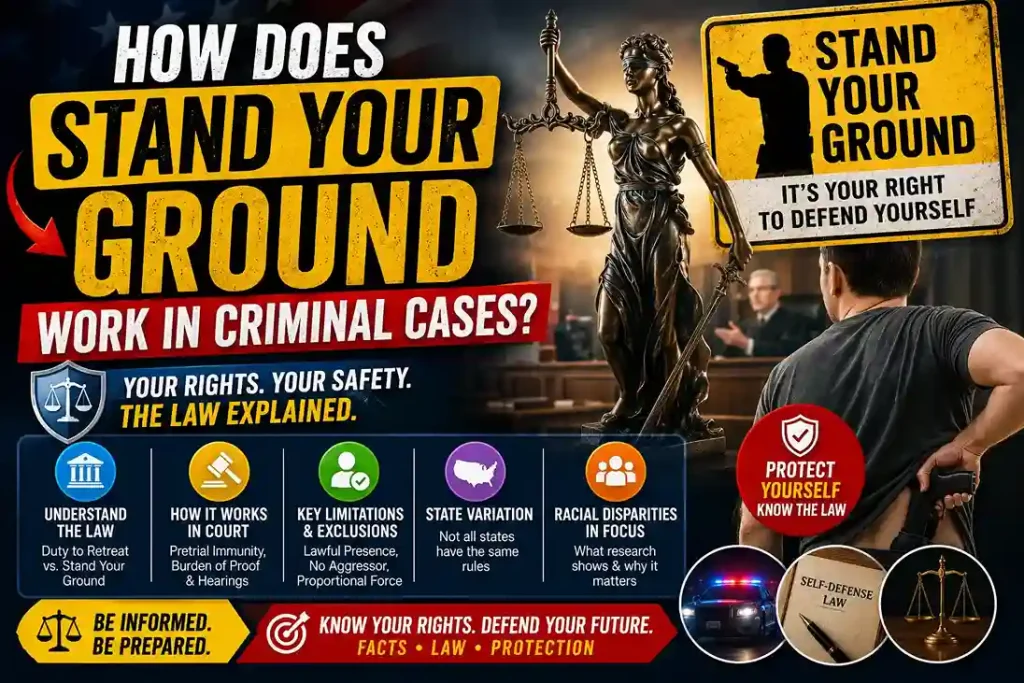
Stand-your-ground laws create an extensive extension of traditional self-defense rules that exist in American legal systems. The laws require an understanding of their operation in criminal cases, which can be achieved by examining their legal framework, newly established procedural safeguards, and current conflicts regarding their actual implementation.
Not all US states have “Stand Your Ground” laws in place. In different parts of the country, self-defense is viewed upon differently from law to law. Is Texas a stand-your-ground state? Is the state where you live a stand-your-ground state? By learning this, you will understand its implications to avoid legal issues regarding self-defense.
Let’s discuss how stand-your-ground laws affect criminal case outcomes.
From Duty to Retreat to Stand Your Ground: The Legal History
Self-defense has been a recognized legal principle in American law since the colonial period. Under traditional common law, a person facing a threat outside their home had a duty to retreat when safe retreat options existed before using deadly force against their attacker. The principle established that violence must remain as the final option, which people should use when they cannot escape from their current situation.
The castle doctrine established an exception to the duty to retreat that existed inside homes. This is according to the legal principle that originated from 17th-century English common law. In this case, people are allowed to defend their homes without needing to retreat. In accordance with this doctrine, one’s residence serves as a secure area where individuals can protect themselves from threats.
Stand-your-ground laws allow individuals to use force without needing to back away. These laws are particularly useful when someone is in areas where they have the right to be, but the self-defense rules remain bound by state laws and judicial decisions. The fundamental requirement, which states that defendants must demonstrate their belief about using force to stop an imminent threat of death or severe bodily damage, remains unchanged.
Florida’s 2005 Law and the National Spread
Florida became the first state to establish a Stand Your Ground law, which became active on October 1, 2005. The National Rifle Association supported the law through the Republican-controlled state legislature during Jeb Bush’s time as governor.
The law of Florida, which exists as Florida Statutes §§ 776.012 and 776.013, extended the Castle Doctrine, which protects home rights to all spaces where a person has legal permission to be present. The law accomplished three objectives. These objectives were removing the common law requirement for retreat, establishing a standard of reasonable fear for intruders who enter homes or vehicles, and granting legal protection to individuals who used force according to the law’s requirements.
Other states followed in rapid succession. The National Rifle Association decided to use Florida’s law as a blueprint for creating national legislation, which resulted in dozens of states passing similar laws within ten years. The total number of states that implement Stand Your Ground laws depends on two factors: the definition of Stand Your Ground and the judicial system’s approach to similar policies through court decisions instead of formal statutes.
How Stand Your Ground Works in Court
In case you face homicide or other related charges for performing an act in accordance with stand-your-ground laws, it is necessary to seek the legal expertise of a criminal defense lawyer. According to criminal defense lawyer Albert Jones, your top priority should be to hire a criminal defense lawyer with the attitude and resourcefulness to take your case as seriously as you do.
The immunity provision represents the main element of Stand Your Ground laws, which serves as their most important operational aspect. Stand Your Ground immunity functions as a trial protection system that prevents defendants from facing trial procedures while traditional self-defense claims exist as affirmative defenses that defendants present during court proceedings. Police officers need to show 12 witnesses as proof against officer immunity on self-defense charges during the pretrial process.
The prosecution needs to prove self-defense immunity as more than just evidence according to Florida law, which requires them to present their case during the pretrial hearing. The 2017 legislative amendment to Florida rules established this current rule, which requires defendants to prove their case according to Florida case law. The distribution of proof requirements differs among states that allow pretrial immunity hearings.
In the event that immunity is granted for the defendant, proceeding to trial is no longer an option. The defendant will still have a basis for claiming self-defense in a subsequent trial despite the lack of a dismissal order. The two-track system establishes a unique difference between Stand Your Ground and standard self-defense laws, starting with pretrial immunity and ending with trial-level affirmative defense.
The focal point of the inquiry will be whether the defendant reasonably believed that the use or threat of force was necessary to prevent imminent death or serious bodily injury. The defendant’s lawful presence and lack of criminal activity will be assessed too.
Limitations and Exclusions
The stand-your-ground law provides limited protection for individuals. The Florida statute establishes that the no-duty-of-retreat rule applies only to individuals who are present at their location in a lawful manner and who do not engage in criminal acts.
A person who initiated or provoked the confrontation cannot claim Stand Your Ground protection unless they clearly withdrew from the encounter and the other party continued to attack. The force used must match the actual level of threat when deadly force is permissible. The defendant must genuinely believe that death or severe bodily harm will occur for a stand-your-ground action to be valid.
State Variation
Florida’s law functions as the primary legal framework that states have adopted in various ways. Some states permit pretrial immunity hearings, which require the prosecution to prove their case, while other states need defendants to present Stand Your Ground as their main defense during court proceedings. The distribution of evidence responsibility between parties shows major differences between different legal systems.
Some states have kept adapted versions of the retreat requirement, which states that individuals must retreat from dangerous situations except when safe escape is possible. The implementation of Stand Your Ground laws results in different outcomes for different jurisdictions because states maintain distinct procedural and substantive legal requirements.
Research on Racial Disparities
The application of Stand Your Ground laws has been examined through scientific research that investigated whether different outcomes were achieved based on the racial identities of the involved parties.
It is widely accepted that Stand Your Ground laws result in the notorious racial disparities in verdicts in justifiable homicide. Based on available data, patterns of the disparities can be confirmed, but it does not provide any insight as to why those disparities exist.
The Urban Institute found that cases where the victim was Black had a higher probability of being classified as justified compared to cases where both the shooter and the victim were white. The study also uncovered a significant disparity in which Black people were more often charged with homicide compared to the far less frequent justified-homicide verdicts for White men who shot Black people.
Experts have realized that there is no contextual data for individual cases in existing databases that would make causality defensible. Backers tend to believe Stand Your Ground laws protect all individuals from equal harm. There may be disparate treatment of individuals due to existing disparities in the criminal justice system, argue the same proponents. The debates over these laws continue among scholars, policymakers, and legal experts.
Stand-your-ground statutes eliminate the common-law duty to retreat before using force in places where a person is lawfully present, broadening the protection offered by the castle doctrine beyond the home.
One can blame the Florida law of 2005 for establishing a framework with both criminal and civil immunity, establishing procedure for pretrial immunity hearings, and determining that it would actually be the job of prosecutors to prove their case during legal hearings.
The defendant’s belief about imminent danger is evaluated through the substantive test, which determines whether he believed danger existed. The causes of racial differences in justifiable homicide decisions have been studied through empirical research, but the reasons behind these differences remain disputed.