

Why Moving Creates More Stress Than Most People Expect
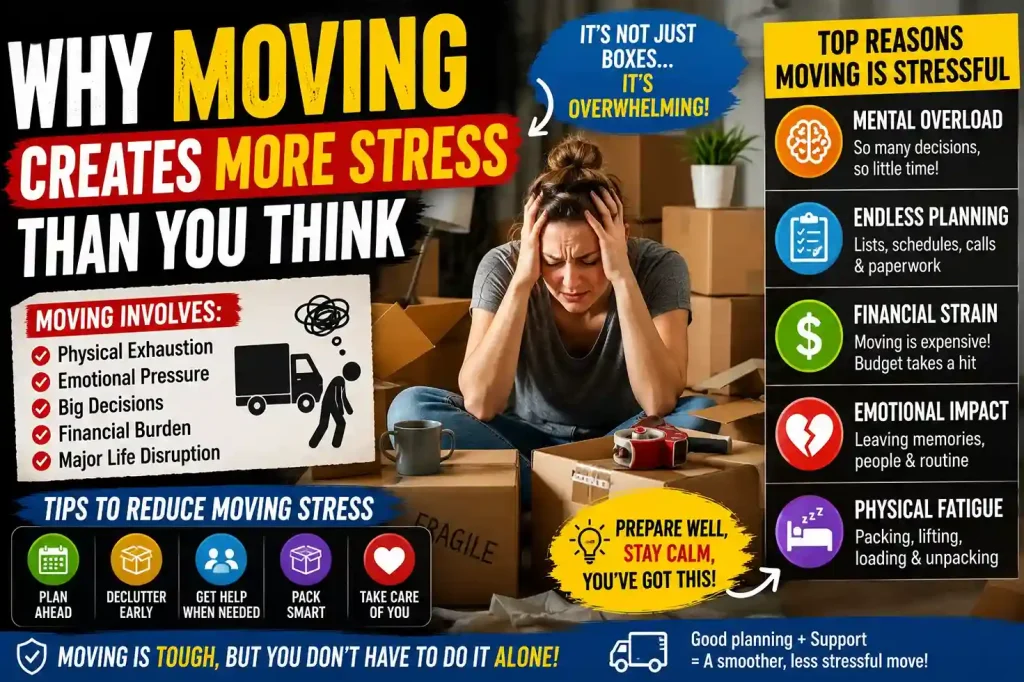
Anyone who’s moved before knows it sounds easier than it is. You picture a couple of weekends sorting boxes, one long moving day, and then a few more weekends of unpacking with a beer in hand. The actual experience? Different story.
Moving consistently appears on major life stress inventories, especially when combined with financial pressure, job changes, or family disruption. The Holmes-Rahe Life Stress Inventory, a well-known stress assessment tool developed in the 1960s, lists a change in residence as a meaningful contributor to overall stress load. And yet a lot of us still treat it like a long weekend with a U-Haul.
Many families reduce the pressure of relocation by working with experienced movers like AQMS National Moving during major transitions. That kind of help can ease the physical strain, but the mental and emotional weight of moving rarely shows up on the truck’s invoice. That’s where the surprise usually hits.
The Hidden Mental Load
Packing isn’t about boxes. It’s about decisions. Hundreds of them, sometimes thousands, made in rapid succession over weeks.
Do you keep the chipped serving bowl from your grandmother? Throw out the kids’ kindergarten art? Donate the third coffee maker you’ve somehow accumulated? Each item carries some weight, and the brain doesn’t get to clock out between choices.
Decision fatigue is real, and it builds quietly. By week three of packing, people often find themselves snapping at partners over breakfast or staring at a closet for twenty minutes without doing anything. The American Psychological Association has written about how chronic decision-making drains cognitive resources, and moving is one of the clearest everyday examples of it.
Logistics That Multiply
So you’ve sorted your stuff. Good. Now there’s the rest.
Changing your address with the bank. Forwarding mail. Updating your driver’s license. Getting your kids into a new school district, sometimes mid-semester. Finding a new dentist. Figuring out which day the trash gets picked up at your new place.
None of this is hard on its own. The trouble is the volume. A typical household move involves dozens of small administrative tasks, and they often pile up at the exact moment when you’re most tired from packing and least available to deal with anything else.
People who’ve moved several times will tell you the second week after arrival is often worse than the move itself. The truck’s gone, the friends who helped have moved on, and you’re left with a kitchen full of boxes and a stack of paperwork you haven’t touched.
The Emotional Side Nobody Warns You About
There’s something almost grief-shaped about leaving a home. Even when the move is voluntary, exciting, and the new place is objectively better.
You walk through empty rooms one last time and remember things. The corner where the dog used to sleep. The wall where you marked the kids’ heights. The neighbor who always brought back your trash bins. None of that comes with you.
Kids handle it differently than adults, and that adds its own layer. They might act out, regress in sleep habits, or just go quiet for a stretch. Spouses sometimes argue more because everyone’s running on shorter patience. Pets often become anxious or disoriented during moves as well, even if they adapt within a few weeks.
The Mayo Clinic and other health organizations have noted that major life transitions can temporarily affect sleep, appetite, and mood. Moving checks every one of those boxes at once.
Why Outside Help Actually Matters
This isn’t a pitch for moving companies. It’s an observation about cognitive bandwidth.
When you handle every part of a move yourself, you’re holding the planning, the physical work, the family management, and the emotional processing all at once. Most people can do two of those reasonably well. Three is a stretch. Four at once usually means something starts to suffer.
Bringing in professional help for the heavy parts doesn’t make you weak or wasteful. It just shifts one big chunk off your back so you can put your energy where it actually matters, like helping your kid adjust or making sure your work doesn’t fall apart during the transition.
A lot of people regret not doing this sooner.
What Helps, From People Who’ve Done It Often
That’s why experienced movers, and people who relocate frequently, tend to focus less on perfection and more on reducing friction wherever they can. People who move often tend to develop the same set of habits over time. They’re not glamorous. But they work.
- Start sorting and downsizing a month before the move, not a week ahead
- Pack a “first night” box with toiletries, sheets, chargers, and coffee supplies
- Set up the bedroom first so you have somewhere calm to retreat to
- Keep important documents in a labeled folder that stays with you
- Eat actual meals during moving week, even if it’s takeout
And probably the biggest one: give yourself permission to be tired and a little off-kilter for a few weeks after. Pretending you’re fine when you’re not just stretching the recovery out.
After the Boxes Are Gone
Settling in takes longer than people expect. Many relocation and mental health experts note that adjusting to a new environment can take several months, especially after long-distance moves.
That timeline doesn’t mean anything is wrong if you’re still feeling unsettled at the three-month mark. It just means the brain takes its time recalibrating to new routines, new sounds, a new commute, new grocery store layouts. All the small invisible things that make a place feel like yours.
Moving is hard. Knowing that ahead of time doesn’t make it easier, exactly, but it does make the stress feel less like a personal failure and more like what it is: a normal response to a genuinely big life event.