

When Motivation Isn’t Enough: Knowing When You Need Real Support
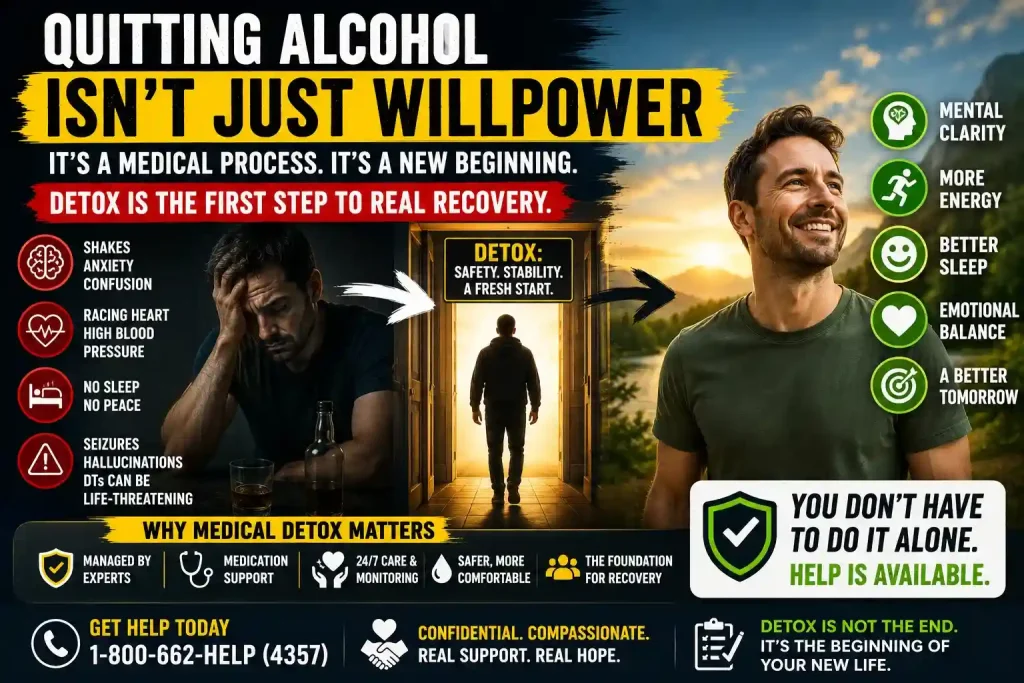
There’s a kind of cruelty in the way we talk about willpower. Wake up, push through, just decide. For a lot of things in life, that advice holds up fine. Quitting alcohol, after the body has come to depend on it, isn’t one of them.
Anyone who’s tried to stop drinking on sheer determination knows the moment when motivation runs out. Maybe it’s day two. Maybe day four. The hands won’t stop shaking, the heart’s beating too fast, sleep stopped happening somewhere around 3 a.m. That’s not a weakness. That’s biology, and it’s the point where having real support starts to matter more than how badly someone wants to quit. For people whose drinking has reached this stage, addiction recovery treatment programs usually begin with one specific phase: detox.
What Detox Actually Does
Detox isn’t the cure. It’s the part that gets the body to a place where the rest of recovery becomes possible. Long-term heavy drinking changes the brain. Alcohol has a depressant effect on the nervous system, and after months or years, the brain compensates by increasing excitatory activity to keep things in balance. Take the alcohol away suddenly, and that compensation has nothing pushing back against it. So you get the shaking, the racing pulse, the anxiety that feels like the walls are closing in.
The clinical name is alcohol withdrawal syndrome. Symptoms typically begin within 6 to 12 hours of the last drink, peak somewhere around 48 to 72 hours, and can stretch out for a week or longer depending on the person.
What Withdrawal Actually Feels Like
Anyone who’s lived through it will describe it differently. Some people get tremors and miserable sleep and a few rough days. Others end up in an emergency room. There’s no reliable way to know in advance which version you’ll get, and that uncertainty is most of the reason this deserves more caution than people give it.
On the milder end, it tends to look like shaking hands, sweating, nausea, an anxiety that feels disproportionate to anything happening in the room, and a kind of sleep that isn’t really sleep. Most people can describe this part because most people have white-knuckled their way through some version of it at least once.
The more severe end is where things change. Seizures can occur with little warning in some cases, even in people who’ve never had one before. Hallucinations can show up around the same window, usually visual, sometimes tactile, and almost always disorienting in a way that’s hard to describe afterward.
And then there’s delirium tremens. Roughly 3 to 10 percent of people going through alcohol withdrawal develop DTs, depending on how severe the dependence is and the population being studied. Without medical care, the historical outcomes were grim. With it, the risk drops substantially, mostly because someone in a clinical setting catches the warning signs early and acts on them before the situation runs away.
The key point is that severity isn’t always predictable in advance.
Why “Just Toughing It Out” Backfires
So this is where motivation-based thinking falls apart. Detox at home, without medical oversight, runs into a few specific problems.
First, the symptoms themselves are miserable enough that most people drink again within a day or two just to make them stop. The body’s pulling hard toward alcohol because alcohol is what it’s adapted to. That’s not a character flaw. That’s pharmacology.
Second, the dangerous symptoms don’t always give a clear warning. Withdrawal seizures can occur suddenly and without much warning, and by the time someone realizes they need help, they may not be in a position to ask for it.
Third, repeated unsupervised withdrawals may make things worse over time. Researchers describe a kindling effect, where each subsequent withdrawal episode tends to be more severe than the last. So the person who tried to quit cold turkey three times before is now facing a fourth attempt that’s harder than any of the previous ones.
What Care Looks Like
The image people carry around about detox is usually wrong. It isn’t dramatic. It’s mostly quiet. Someone checks vital signs. Someone asks how you’re feeling and actually pays attention to the answer. Medications are sometimes used in tapering doses to settle the nervous system and lower the risk of seizures. Sleep and hydration get attention. The body gets a chance to come back to a baseline it hasn’t seen in years.
Most people stay in a detox setting for around 5 to 7 days, give or take. The goal isn’t to fix everything that led to the drinking. That part comes later. The goal is to get someone medically stable and clear-headed enough to actually take the next step.
What matters most is the bridge to whatever comes after. Outcomes improve significantly when detox connects to continued treatment rather than ending as a standalone event. SAMHSA’s TIP 45 protocol on detoxification describes detox as a doorway rather than a destination, and reputable programs are designed around that idea.
The same framing appears in materials from the National Institute on Alcohol Abuse and Alcoholism. Their overview of treatment for alcohol problems describes withdrawal management as the entry point to a longer process. Same message, different source.
Why Structure Changes the Outcome
Here’s the part that gets overlooked. People often think of detox as the goal. Get through it, and you’ve quit. Except quitting and staying quit are different problems, and the second one is harder.
Structured programs help long-term outcomes because they handle three things at once. The body gets stabilized. The person gets enough rest and support to start thinking clearly again, which usually doesn’t happen until day four or five. And the transition into whatever comes next, whether that’s residential rehab, intensive outpatient, or some combination, gets handled while the person is still in a supportive environment.
That last piece might be the most underrated one. The window between finishing detox and starting the next phase is when many people relapse. Programs that close that gap, rather than leaving someone to figure it out solo, tend to see better results.
There’s also the medical history side of it. Heavy drinkers often have undiagnosed conditions. High blood pressure. Fatty liver. Vitamin deficiencies, especially thiamine, which can lead to a serious neurological condition called Wernicke’s encephalopathy if it’s not caught. A good program screens for all of that. Someone trying to quit at home doesn’t have that safety net.
Knowing When to Make the Call
Most people who need this kind of help already know on some level. They just hope they don’t. The signs tend to be pretty consistent:
- Drinking daily, often in the morning, to keep shakes or anxiety away
- Previous attempts to quit that ended with severe physical symptoms
- A history of seizures, hallucinations, or DTs during past withdrawal
- Heavy drinking that’s continued for months or years
- Co-occurring depression, anxiety, or chronic pain
- Underlying health issues that make unmonitored withdrawal risky
If any of those line up, the answer isn’t trying harder. It’s getting help from people who do this for a living.
Motivation matters. Wanting to stop matters. But somewhere in the equation, the body has to be brought along too, and that asks for more than willpower. It asks for care. The people who succeed in long-term recovery usually didn’t muscle their way through detox alone. They got the medical support that made the rest of recovery possible, and they used it.
So if you’re sitting with the question of whether you can do this on your own, the honest answer is probably no, and that’s fine. Very few people do it safely without support. The ones who made it work had help. That’s not a failure of motivation. That’s just how this works.