Palmer Luckey and Jeff Greene: Two Billionaires Who Took Different Paths to Success
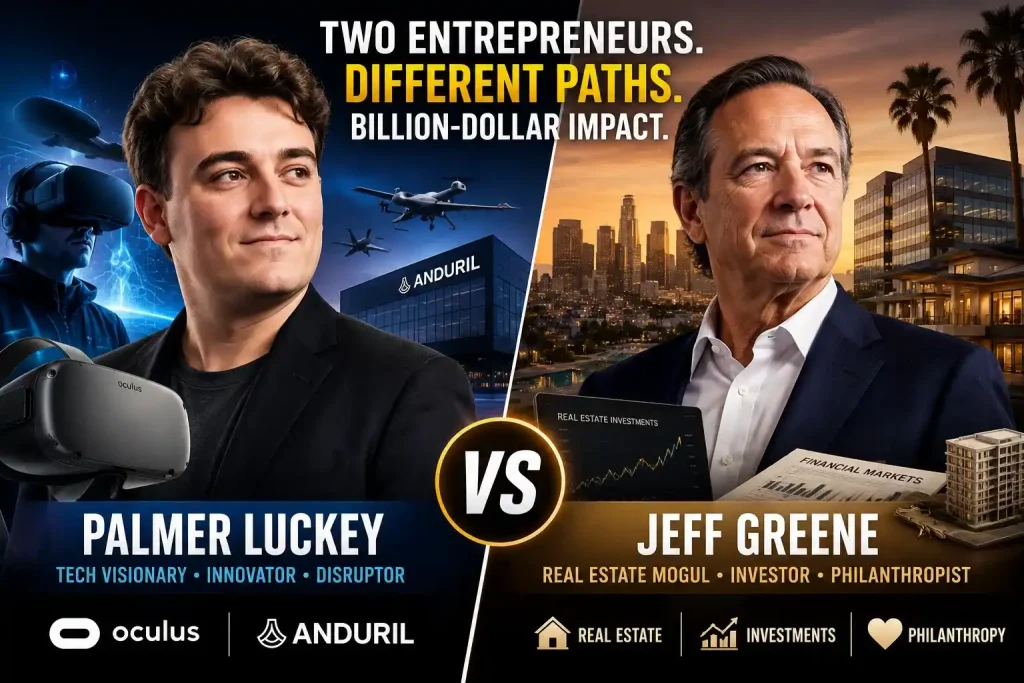
Palmer Luckey and Jeff Greene built their fortunes in completely different industries.
Luckey became a major technology entrepreneur through virtual reality and defense technology. Greene built his wealth through real estate, financial markets, and large property investments.
Their age difference is significant, yet both followed an entrepreneurial approach based on calculated risk, long-term thinking, and identifying opportunities before others.
Who Is Palmer Luckey?
Palmer Freeman Luckey is an American technology entrepreneur best known for creating Oculus VR.
Born on September 19, 1992, Luckey developed an early interest in electronics, computers, gaming, and engineering. As a teenager, he spent considerable time building and modifying electronic devices.
His interest in virtual reality eventually led him to develop an early version of the Oculus Rift.
That project became the foundation of his first major business success.
Palmer Luckey’s Early Years
Luckey was homeschooled by his mother while his father worked at a car dealership.
During his teenage years, he experimented with:
- Electronics
- Computers
- Gaming systems
- Virtual reality hardware
- Engineering projects
He later attended California State University, Long Beach.
However, he left college before completing his degree as his technology business began attracting significant attention.
The Creation of Oculus VR
Luckey founded Oculus VR in 2012.
The company focused on developing virtual reality hardware that could provide immersive gaming experiences without the limitations of earlier headsets.
The Oculus Rift quickly attracted attention from gaming enthusiasts and developers.
A successful Kickstarter campaign helped fund early development and increased awareness of the technology.
The project eventually attracted major interest from the technology industry.
Facebook’s Oculus Acquisition
In 2014, Facebook announced its acquisition of Oculus VR for approximately $2 billion in cash and stock.
Luckey was only 21 years old at the time.
The transaction became one of the most notable technology acquisitions involving a young entrepreneur.
It also established Luckey as a significant figure in the emerging virtual reality industry.
Palmer Luckey After Oculus
Luckey later left Facebook and moved into a very different area of technology.
Instead of focusing primarily on consumer virtual reality, he turned his attention toward defense technology.
In 2017, he co-founded Anduril Industries.
The company develops technology involving areas such as:
- Autonomous systems
- Drones
- Artificial intelligence
- Defense software
- Surveillance technology
- Military technology
This represented a major change from Luckey’s earlier work in gaming hardware.
Anduril Industries
Anduril became Luckey’s second major entrepreneurial success.
The company attracted substantial investment as demand for autonomous defense systems and artificial intelligence increased.
Its technology combines software, sensors, autonomous systems, and hardware for defense applications.
Luckey’s transition from virtual reality to defense technology demonstrates his willingness to move into emerging industries.
Who Is Jeff Greene?
Jeff Greene is an American real estate investor, entrepreneur, and philanthropist.
His route to wealth was very different from Luckey’s.
Greene developed his financial career through real estate, investments, and financial markets.
He was born on December 10, 1954, in Worcester, Massachusetts.
His early life included various jobs that helped support his education.
Jeff Greene’s Education
Greene attended Johns Hopkins University, where he studied economics and sociology.
He later earned an MBA from Harvard Business School.
During his education, he worked several jobs and searched for opportunities to finance his studies.
His early experiences helped shape the practical approach he later brought to investing.
Jeff Greene’s First Real Estate Investments
Greene began investing in property while studying at Harvard.
One of his early purchases was a three-family property near Boston.
He lived in part of the property and rented the remaining units.
This approach allowed him to generate rental income while building equity.
By the time he graduated from Harvard Business School, his property portfolio had reportedly expanded considerably.
Building a Real Estate Empire
Real estate eventually became the foundation of Greene’s wealth.
His investments expanded into major American markets, including:
- Los Angeles
- New York
- South Florida
His portfolio has included residential properties, apartment buildings, commercial properties, and luxury real estate.
Greene’s strategy relied heavily on acquiring valuable properties and holding investments over long periods.
Jeff Greene and Financial Markets
Real estate was not Greene’s only source of wealth.
He also became involved in financial markets.
One of the most notable examples came before the 2008 financial crisis, when Greene took positions involving credit default swaps linked to subprime mortgage-backed securities.
When the housing market collapsed, those positions generated substantial returns.
Greene subsequently used capital from his financial success to expand his real estate investments.
This created an important difference between the two entrepreneurs.
Luckey built his first major fortune by creating technology, while Greene used financial markets and real estate to build his wealth.
Palmer Luckey and Jeff Greene: Two Different Investment Strategies
Palmer Luckey and Jeff Greene reached billionaire status through very different approaches.
Luckey built businesses around emerging technology. Greene built wealth through property ownership, financial markets, and long-term investments.
Their careers show how different risk strategies can produce major financial success.
Palmer Luckey’s Entrepreneurial Strategy
Luckey’s career began with a technical problem.
Early virtual reality systems were often expensive, bulky, and difficult to use. Instead of accepting those limitations, Luckey experimented with new hardware designs.
That experimentation eventually produced the Oculus Rift.
His approach involved:
- Developing new technology
- Testing hardware
- Identifying consumer demand
- Working with engineers
- Attracting investors
- Expanding into new markets
The Oculus acquisition gave Luckey his first major financial breakthrough.
From Gaming to Defense Technology
Luckey did not stop after Oculus.
His move into defense technology through Anduril demonstrated a willingness to take another major entrepreneurial risk.
Anduril operates in areas involving autonomous systems, artificial intelligence, drones, surveillance, and defense technology.
This business model differs considerably from consumer gaming.
Instead of developing products primarily for individual consumers, Anduril focuses on sophisticated technology for defense applications.
Jeff Greene’s Investment Strategy
Greene developed his wealth through a combination of real estate and financial investments.
His strategy has involved identifying assets that could appreciate over time while generating additional income.
Real estate became particularly important to his portfolio.
His investment interests have included:
- Apartment properties
- Commercial buildings
- Luxury residences
- Development projects
- Financial assets
- Equities
His strategy demonstrates the value of combining multiple investment categories.
The 2008 Financial Crisis
Greene’s financial career received considerable attention because of his position before the housing crisis.
He purchased credit default swaps connected to subprime mortgage-backed securities.
When the housing market deteriorated, those positions generated a substantial return.
Greene subsequently directed much of that capital toward real estate.
This became one of the defining financial events of his career.
Palmer Luckey vs. Jeff Greene
| Category | Palmer Luckey | Jeff Greene |
|---|---|---|
| Birth Year | 1992 | 1954 |
| Main Industry | Technology and Defense | Real Estate and Finance |
| First Major Success | Oculus VR | Financial and Property Investments |
| Major Business | Anduril Industries | Real Estate Ventures |
| Core Strategy | Technology Entrepreneurship | Asset Investment |
| Education | California State University, Long Beach | Johns Hopkins and Harvard Business School |
| Main Risk | Emerging Technology | Financial Markets and Property |
| Wealth Foundation | Technology Ownership | Real Estate and Investments |
The comparison shows how differently their careers developed.
Age and Generational Differences
Luckey and Greene belong to different generations of entrepreneurs.
Luckey entered the technology industry during the rise of virtual reality, artificial intelligence, autonomous systems, and advanced consumer electronics.
Greene built his career during decades of major changes in American real estate and financial markets.
Their experiences therefore reflect different economic environments.
Their Approach to Risk
Risk is one of the strongest similarities between them.
Luckey took entrepreneurial risks by investing his time and resources into technologies that were still developing.
Greene took significant financial positions based on his assessment of housing and credit markets.
The risks were different, but both relied on identifying opportunities before they became obvious to the wider market.
Business Connection Between Palmer Luckey and Jeff Greene
There is no documented direct business partnership between Palmer Luckey and Jeff Greene in the provided material.
Their names may appear together because both are wealthy American entrepreneurs with interests in investment and high-value assets.
However, their primary businesses developed independently.
Luckey’s interests center on:
- Anduril
- Oculus
- ModRetro
- Defense technology
- Gaming hardware
Greene’s interests center on:
- Real estate
- Financial investments
- Luxury properties
- Equities
- Philanthropy
No joint company or major shared investment is identified in the supplied information.
How Palmer Luckey and Jeff Greene Built Their Wealth
Palmer Luckey and Jeff Greene followed different routes to financial success, but both benefited from identifying opportunities and taking calculated risks.
Luckey built businesses around technology and innovation. Greene focused on financial markets, real estate, and long-term asset ownership.
Palmer Luckey’s Wealth
Luckey’s wealth is closely connected with his ownership interests in technology companies.
His first major financial breakthrough came from Oculus VR.
The company developed virtual reality hardware and eventually attracted a major acquisition offer from Facebook.
Luckey later built another valuable technology business through Anduril Industries.
His wealth therefore depends heavily on the value of private technology companies and his ownership stakes in them.
Technology as a Wealth Engine
Luckey’s career demonstrates how emerging technologies can create substantial financial opportunities.
His major areas of interest include:
- Virtual reality
- Defense technology
- Artificial intelligence
- Autonomous systems
- Gaming hardware
His work with ModRetro also shows that he has maintained an interest in consumer gaming technology.
Jeff Greene’s Wealth
Greene’s wealth developed through a broader combination of financial assets and property.
Real estate became the foundation of his long-term portfolio.
His investments have included:
- Residential properties
- Apartment buildings
- Commercial real estate
- Luxury homes
- Development projects
- Financial investments
Property ownership provided Greene with both potential appreciation and recurring income opportunities.
Why Real Estate Became Important to Greene
Real estate offered Greene a way to reinvest capital into tangible assets.
After generating significant returns from financial markets, he redirected capital toward property investments.
This helped him build a portfolio that could continue producing value across different market cycles.
His strategy demonstrates how one successful investment can provide capital for future opportunities.
Comparing Their Wealth-Building Models
| Palmer Luckey | Jeff Greene |
|---|---|
| Technology ownership | Real estate ownership |
| Virtual reality | Property development |
| Defense technology | Financial investments |
| Private technology companies | Commercial and residential properties |
| Entrepreneurial growth | Asset accumulation |
| Innovation-driven | Investment-driven |
Their wealth-building models reflect their professional expertise.
Philanthropy and Personal Interests
Jeff Greene has also directed part of his wealth toward philanthropic activities.
Education has been an important area of interest, including support associated with the Greene School in Palm Beach.
His philanthropic activities complement his broader business career.
Luckey’s public interests are more closely connected with technology, gaming, engineering, and innovative hardware.
His involvement with ModRetro reflects his continued interest in gaming technology.
Public Profile
The two entrepreneurs also maintain very different public profiles.
Luckey has received significant attention because of his technology ventures, political activities, defense company, and unusual engineering interests.
Greene is better known for his real estate portfolio, financial success, luxury properties, and investment activities.
Both attract media attention, but for different reasons.
Could Their Careers Overlap?
Technology and real estate increasingly intersect through areas such as artificial intelligence, smart buildings, autonomous systems, and digital infrastructure.
However, broad industry overlap does not establish a personal connection.
There is no documented evidence in the supplied material showing that Luckey and Greene jointly developed a company, property, investment fund, or technology project.
Their careers remain independent.
What They Have in Common
Despite their differences, several characteristics can be compared.
Both entrepreneurs:
- Took significant calculated risks
- Built wealth through ownership
- Looked for opportunities outside traditional career paths
- Expanded into multiple business interests
- Maintained long-term investment perspectives
- Built substantial fortunes through independent strategies
Their stories demonstrate that there is no single route to entrepreneurial success.
Final Comparison
Palmer Luckey represents a technology-driven model of entrepreneurship.
His career moved from virtual reality to defense technology and gaming hardware.
Jeff Greene represents an investment-driven model of wealth creation.
His career moved from financial markets into extensive real estate ownership and development.
There is no established business partnership between the two. Their main similarity is that both recognized opportunities in areas where they believed they could create substantial long-term value.