

Lost Signal? Why Walkie Talkies Still Work When Phones Don’t
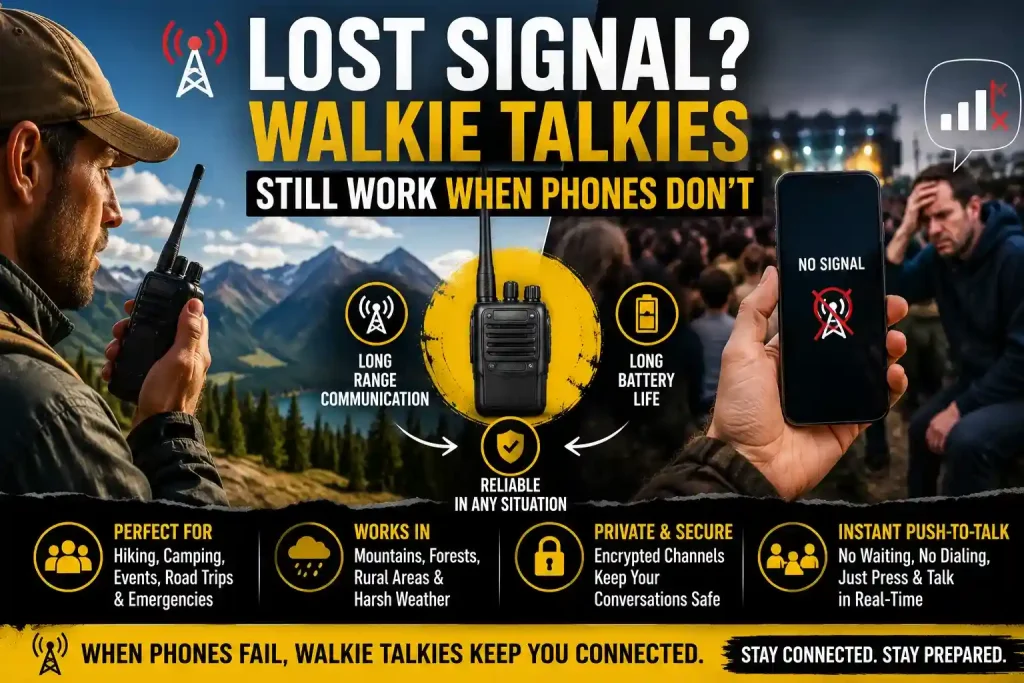
It always happens at the worst possible moment.
You’re halfway through a road trip. Or hiking in the mountains. Or sitting in a stadium packed with 70,000 people all trying to upload the same blurry concert video at exactly the same time.
You glance at your phone expecting a signal.
Nothing.
Maybe one weak bar appears for half a second before disappearing again like it regrets giving you hope in the first place. Messages won’t send. Calls fail instantly. Navigation freezes mid-route. And suddenly everyone starts doing that universal modern ritual: holding phones toward the sky like they’re trying to contact satellites through positive thinking alone.
Meanwhile, somewhere nearby, a pair of walkie talkies keeps working perfectly fine.
No drama. No buffering. No desperate search for Wi-Fi.
Just communication.
Walkie talkies often last much longer than smartphones during emergencies and outdoor trips.
Perfect for hiking, camping, road trips, mountains, forests, and rural travel.
Push a button and speak immediately without dialing or waiting for networks.
Ideal for concerts, festivals, sports events, and crowded public gatherings.
Cell Phones Depend on More Infrastructure Than People Realize
Smartphones feel incredibly reliable, right up until the infrastructure supporting them starts struggling.
Cellular communication depends on towers, network traffic, signal availability, power systems, and bandwidth capacity all functioning properly at the same time. Most of the time, that works well enough that people stop thinking about it entirely.
Then a storm rolls through. Or a crowd overwhelms local networks. Or someone drives into a rural dead zone where coverage maps become more of a creative writing exercise than factual information.
That’s where walkie talkies start looking surprisingly smart.
Unlike traditional cell phones, many walkie talkie systems can communicate directly or operate through broader radio and push-to-talk communication networks that don’t rely entirely on local cellular congestion. That independence gives them a major reliability advantage in situations where phones become inconsistent or completely unusable.
Which, honestly, happens more often than most people expect.
Large Crowds Break Phone Networks Constantly
Anyone who has attended a major event already knows this pain.
Concerts. Festivals. Sporting events. Parades. Emergency evacuations. The moment thousands of people gather in one place, phone networks start acting like exhausted employees on the last day before vacation.
Calls fail. Texts arrive twenty minutes late. Apps refuse to load.
The problem isn’t your phone. It’s network congestion.
Modern walkie talkies avoid much of this issue because communication happens differently. Push-to-talk systems allow direct, immediate communication without competing against thousands of simultaneous social media uploads, streaming videos, and group chats titled “WHERE IS EVERYONE???”
That immediate reliability becomes incredibly useful during crowded events where coordination matters and cellular service becomes unpredictable.
Because trying to reunite a separated group using delayed text messages is basically modern-day chaos management.
Remote Areas Expose Smartphone Weaknesses Fast
There’s something oddly humbling about watching a $1,000 smartphone become completely useless because you drove thirty minutes outside the city.
Camping trips, hiking trails, national parks, remote highways, and rural areas all reveal the same uncomfortable truth: coverage disappears quickly once infrastructure disappears with it.
Modern walkie talkies thrive in exactly those situations.
Many systems are specifically designed for outdoor communication where reliability matters more than internet access. Long-range communication capabilities, radio-based connectivity, and nationwide push-to-talk systems allow users to stay connected in places where smartphones often struggle badly.
Which explains why outdoor travelers, road trip groups, off-road communities, and emergency preparedness enthusiasts continue relying on them heavily.
Nature has never cared very much about your cellular provider.
Battery Life Quietly Becomes a Huge Advantage
Smartphones are multitasking machines.
Navigation, streaming, messaging, apps running invisibly in the background, constant notifications, cameras, social media, modern phones burn through battery life aggressively. Add weak signal conditions into the mix and batteries drain even faster while devices desperately search for service.
Walkie talkies are different because communication is their primary purpose.
That focused functionality often allows modern systems to operate far longer without constant charging. During emergencies, outdoor travel, long work shifts, or extended power outages, that reliability matters enormously.
Because communication devices become significantly less helpful once they turn into expensive black rectangles with dead batteries.
Instant Communication Still Wins
One of the biggest reasons walkie talkies remain so useful is speed.
No unlocking screens. No dialing numbers. No waiting for calls to connect while networks struggle. Push button. Speak immediately. Receive response instantly.
That simplicity matters during emergencies, travel coordination, outdoor adventures, or any situation where delays create confusion.
People tend to underestimate how valuable immediate communication feels until other systems stop cooperating.
Then suddenly, simple technology starts looking very impressive.
Modern Walkie Talkies Quietly Evolved
A lot of people still picture walkie talkies as old-school radios with static-filled audio and limited range.
The technology moved far beyond that years ago.
Today’s walkie talkies often include clearer digital audio, long-range communication, GPS features, weather-resistant designs, encrypted channels, and even nationwide connectivity capabilities that dramatically outperform traditional radios many people remember.
They evolved while keeping the one feature people actually care about most: reliability.
Reliable Communication Matters More Than Ever
Modern life assumes constant connectivity. But the moment signals disappear, most people realize how dependent they’ve become on fragile communication systems.
That’s exactly why walkie talkies continue thriving despite all the advances in smartphones and wireless technology. They offer something increasingly valuable: dependable communication when other systems fail, overload, or simply stop cooperating.
And when phones lose signal at the worst possible moment, reliability suddenly becomes the most important feature of all.