
Future-Proofing Your Life Science Business with Integrated Digital Strategies
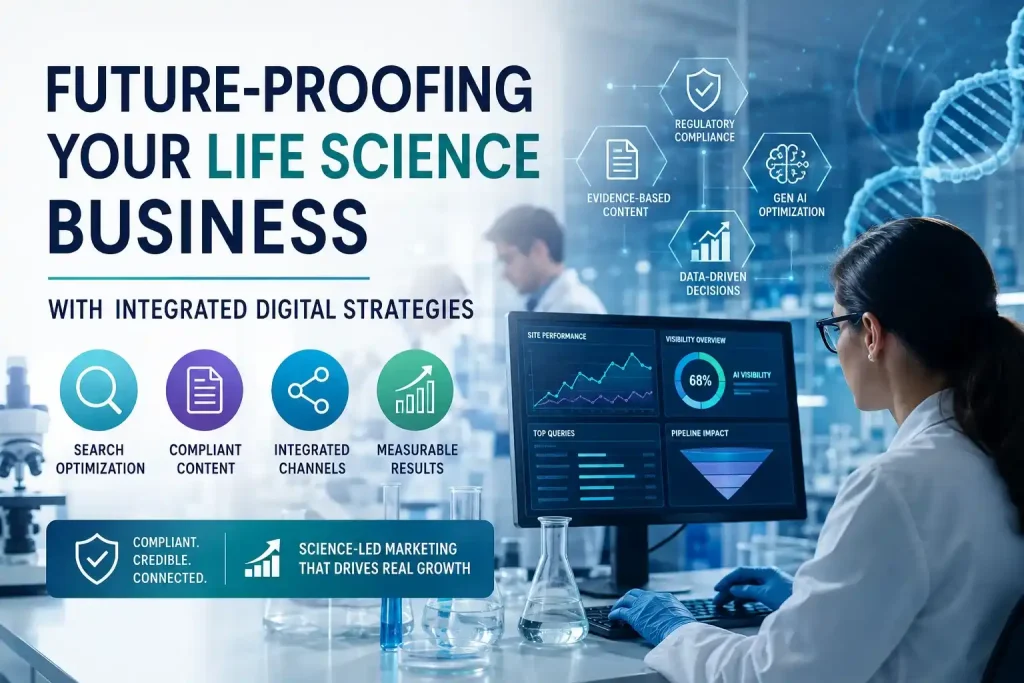
“Integrated” is one of the most abused words in marketing. Used carelessly it means nothing more than doing several things at once. Used precisely, in a life science context, it describes the fix for a specific and expensive failure that almost every commercial team in the sector recognises.
The failure is structural, not creative
Walk into most life science marketing departments and you will find good people producing good work that does not add up.
The scientific affairs team writes technically excellent material that never gets optimised for search. The digital team runs campaigns against content they had no hand in shaping. Regulatory review sits at the end of the process rather than the beginning, so approved assets arrive weeks after the moment they were meant to support. Analytics live in a separate system from the campaign that generated them, so nobody can say with confidence which activity produced pipeline.
Nothing here is a talent problem. It is a sequencing problem, and no amount of additional content fixes it.
Why this sector is harder than most
Three characteristics make life science marketing structurally different from general B2B.
The audience checks your work. Researchers, clinicians, and procurement teams read for evidence, not persuasion. Content that overstates gets discarded on first read, and the credibility loss is difficult to recover.
The compliance layer is real. Medical, legal, and regulatory review is not an obstacle to route around, and campaigns built without it in mind stall at exactly the point they were meant to launch. Teams that fold review into the production process rather than bolting it on at the end move considerably faster.
The buying cycle is long and multi-stakeholder. A single decision may involve a principal investigator, a lab manager, a procurement function, and a finance approver, each needing different material at different depths.
The search shift is not hype
The most consequential change underway is where technical audiences actually look for information. Scientists and decision makers increasingly ask conversational questions of AI tools and act on synthesised answers rather than working down a list of blue links.
This matters because ranking and being cited are no longer the same thing. Analysis cited by SCORR Marketing found that roughly half the sources appearing in Google’s AI Overviews also rank in the top ten organic results, which means close to half do not. Traditional rankings no longer guarantee that your content is the material an AI system draws on when a researcher asks about your category.
Closing that gap is a technical and editorial exercise. Structured data using Schema.org gives machines explicit context about what your content asserts. Formats that generative models favour, including clear question and answer structures, comparison tables, and defined terminology, make content easier to parse and cite. Building life sciences SEO and generative engine optimisation into the same workflow means the work is done once rather than retrofitted later.
What integration means in practice
Three things, concretely.
Content is planned against evidence and search demand simultaneously, so the piece that answers a real scientific question is also the piece that can be found. A market development strategy that ignores how the audience searches is a plan with a distribution gap built into it.
Regulatory review is designed into the calendar rather than discovered at the end of it. Teams that map review cycles into production timelines stop treating compliance as a delay.
Measurement is unified. Traffic, ranking, AI visibility, engagement, and pipeline sit in one view. Without that, optimisation is guesswork wearing a dashboard.
The measurement question, honestly
Attribution in this sector is genuinely difficult. Long cycles, offline conversations, and multi-touch committee decisions mean nobody should promise clean single-source attribution.
What is achievable is directional confidence. Consistent tracking through Google Analytics and Search Console, combined with monitoring of AI visibility and ranking movement, tells you which content compounds and which does not. Published case work in the sector shows what this looks like when it holds together: growth in impressions and organic traffic in the triple digits, meaningful reductions in wasted media spend, and content functions built to run without permanent agency dependence.
Where to start
Audit the sequence, not the output. If your content, search, compliance, and analytics functions cannot describe a single shared workflow, that is the problem worth solving before anything else.
Sciencia Consulting is a San Diego based consultancy delivering marketing for life sciences and techbio companies, combining PhD-level scientific expertise with digital strategy, content, SEO, and generative search optimisation. The team has built marketing functions from the ground up for organisations ranging from early-stage biotech to Abbott, Kite, and J&J Innovative Medicine.